Every product on Whop produces verified data. The orderbook produces matched trades. PnL Cards turn those trades into permanent records. The Indicator Marketplace produces certified backtests and live performance. Signal groups produce timestamped calls. Vaults produce contributor returns. All of it is attributed to a .whop name.
That's a lot of data. The four surfaces below are how that data becomes searchable, consumable, and monetizable.
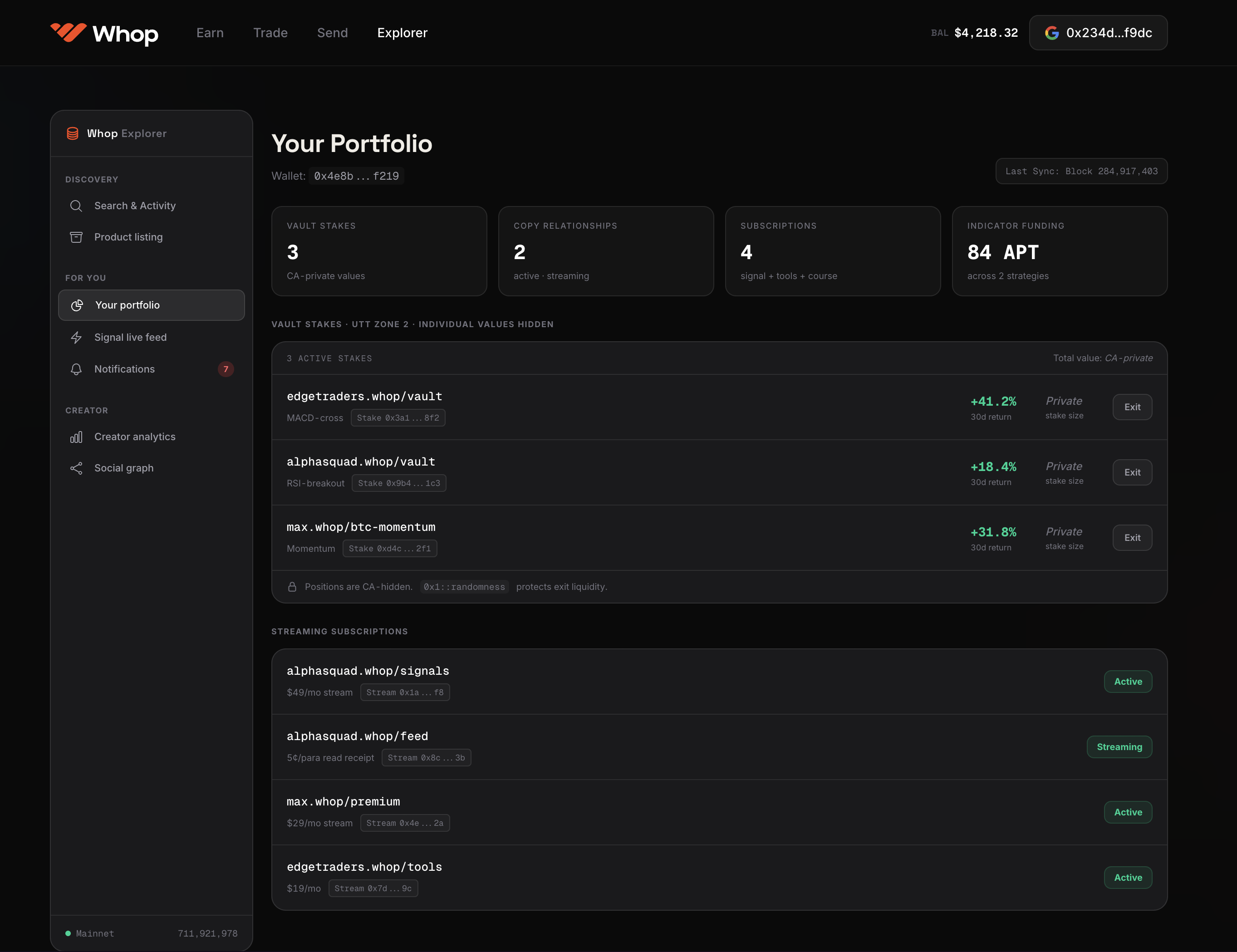
- ›Explorer is the discovery and reputation surface. You go to Explorer to look someone up, browse the leaderboard, search Feed articles, or evaluate an indicator before subscribing. Free to browse summaries. Pay to unlock individual paragraphs or full articles. Pull-based.
- ›Terminal is the live monitoring dashboard for active traders during market events. You don't browse Terminal. You subscribe to the streams you care about and let them push to you in real time, billed per second only while you're watching. Push-based.
- ›Feed is the paid content layer that signal callers, analysts, and news organizations publish to. Billed by the paragraph. Surfaces inside both Explorer (search and discovery) and Terminal (live headline cards).
- ›Content Rewards is the payment rail that distributes revenue back to creators based on the attribution chain.
The Explorer/Terminal distinction matters: Explorer is the reputation graph (who is this person, what's their verified history). Terminal is the operational console (what's happening right now, who do I need to watch). Same underlying data, different consumption model. Bloomberg analogy: Explorer is to Bloomberg's company pages what Terminal is to the Bloomberg Terminal itself.
All four share one identity graph (.whop names), one storage layer (Shelby), and one payment model (CA streams).
Whop Explorer
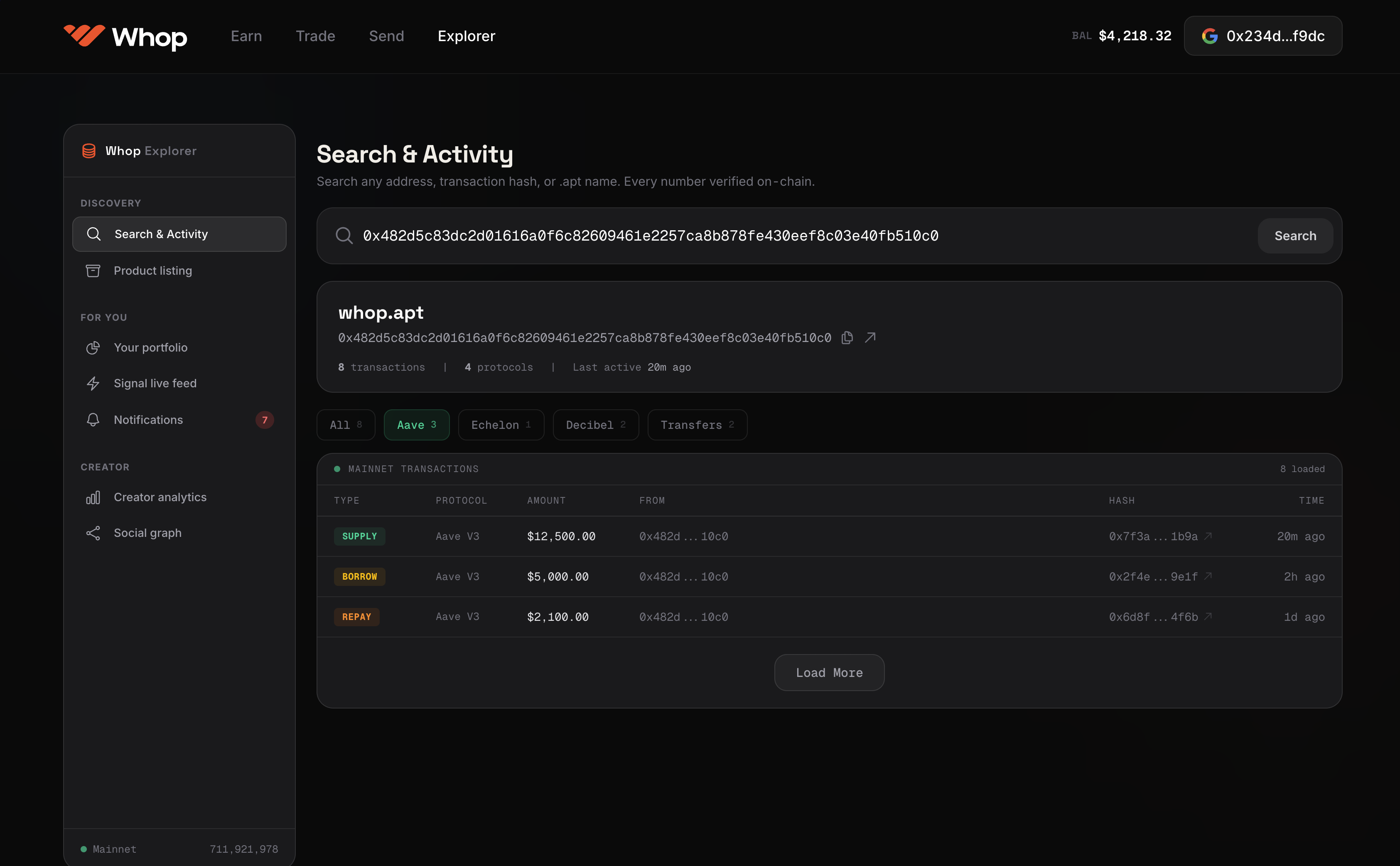
You type max.whop in the search bar and get the full verified profile. Every trade timestamped by UTT nullifier, so the timestamp can't be backdated. Every dollar PnL proven by Reclaim zkTLS against the actual exchange account, so Whop never sees the raw data. Every signal call with the time between entry and publication, onchain instead of self-reported. Every chart replay watchable on Shelby. Every indicator they use, with its own backtest and live Sharpe sitting next to the indicator creator's name. Every article they've written, every vault they manage, every Content Rewards payout.
This is the part that makes existing trading leaderboards look like marketing pages. Existing leaderboards show you a number. PnL. Win rate. You have no idea if it's real, who generated it, or whether the person has been consistent or just got lucky in a quarter. Explorer's .whop profile shows the receipts.
QVAC (Tether AI), the natural language query engine built on Aptos indexer data, can reason across all of it. "Show me traders with a verified win rate above 60% who traded BTC in the last 30 days." Resolves against ZK-proven stats without touching raw trade data. "Show me vaults running RSI strategies with live Sharpe above 1.5 over 3 months." Resolves against the indexed vault state. Every .whop name is a QVAC entity, and every artifact those names produce (trades, signals, indicators, articles, clips, vaults) is hung off the same identity.
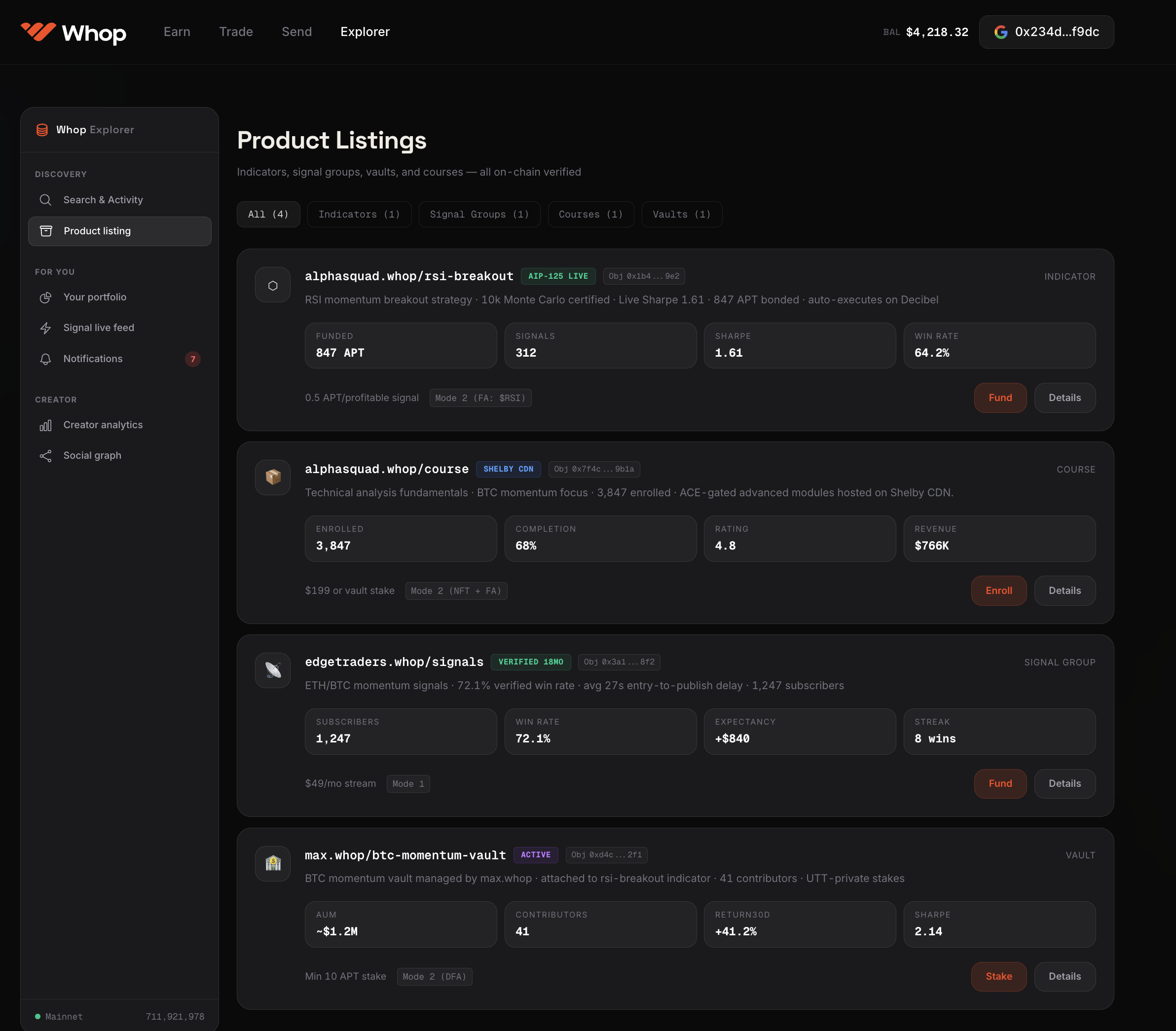
The overfitting flag
Backtest Sharpe and live Sharpe sit side by side for every indicator. A 2.4 backtest with a 0.6 live Sharpe after 3 months is curve-fitting, and Explorer says so. If an indicator hasn't fired in 30 days or live Sharpe drops below threshold, Explorer surfaces the staleness flag. Zombie indicators don't get to coast on old backtest numbers at the top of the leaderboard.
Search drives discovery
Full-text search runs across Feed articles and course content. You see the title and first paragraph for free. The body is ACE-encrypted on Shelby. You pay to unlock specific sections, not the whole article. This makes search a surface that drives traffic into paid content without giving the content away first.
Whop Terminal
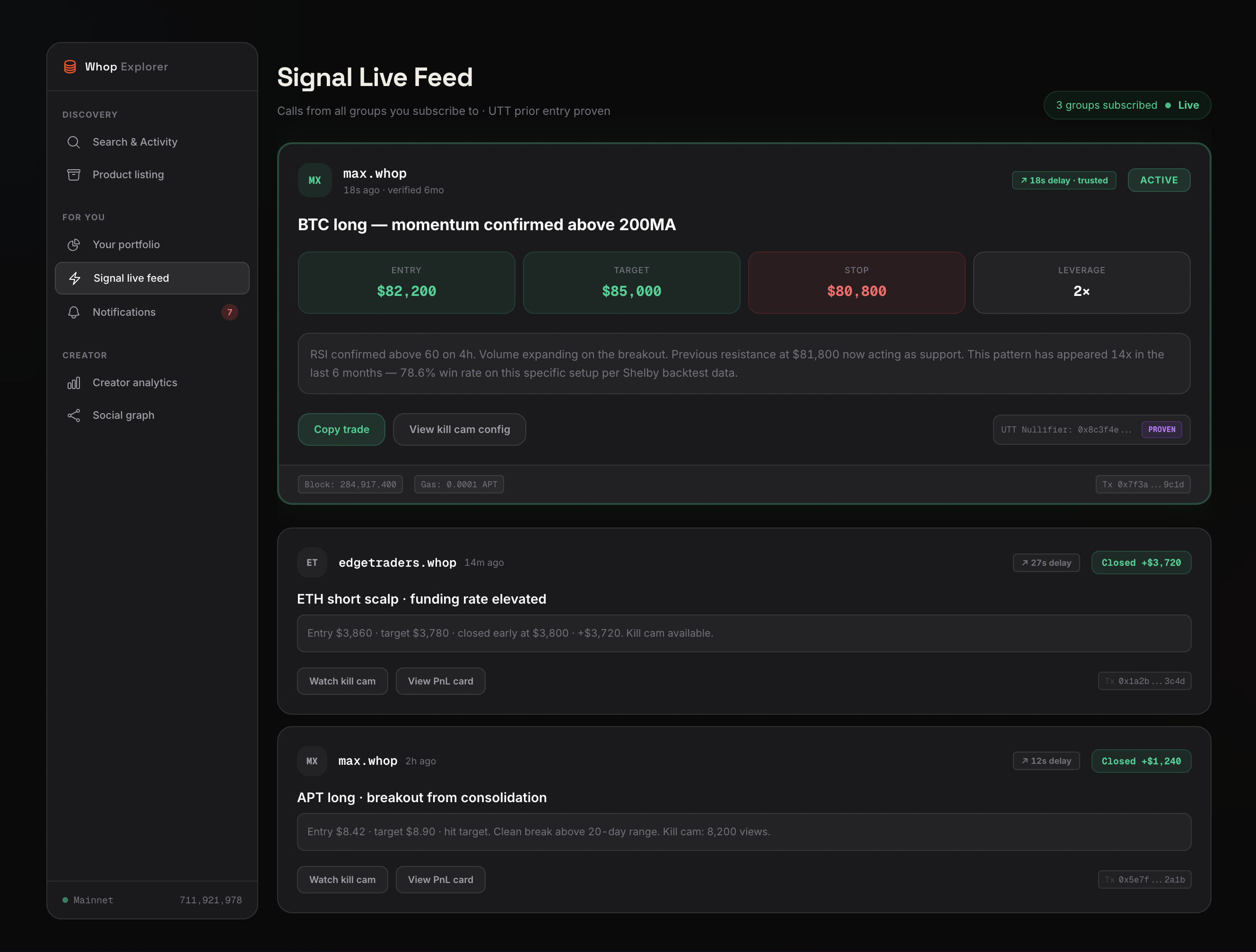
Terminal is Explorer rendered as a live monitoring dashboard, with everything billed by the second. You add the data streams you care about, you stop watching, you stop paying. There's no monthly subscription you forgot to cancel.
Each stream is a CA micropayment. Premium streams push ACE-encrypted ciphertext over WebSocket. Subscribers decrypt. Everyone else gets useless ciphertext. When your subscription lapses, the contract returns false, no new keys get released, and the stream goes dark. Revocation is clean.
Pricing adapts to what's happening. A market crash or a liquidation cascade spikes the per-second rate automatically. Idle market data is cheap. Active markets cost more. You're paying for the moments where the data actually matters.
The streams Terminal exposes:
- ›Signal group momentum (a caller's PnL spike or a chart replay going viral surfaces immediately)
- ›Breaking Feed articles (premium headline cards. Subscribers see the full article inline, others see the teaser and can pay to unlock without leaving Terminal)
- ›Viral chart replays (engagement-driven momentum, no need to watch every clip)
- ›Real-time
.whopname watchlist (PnL updates, signal fires, clip virality on the names you care about) - ›Semantic search over Whop accounts, Aptos addresses, and Shelby content
- ›Historical candle data from Shelby, queryable for backtesting indicators inside Terminal
- ›Live QVAC commentary on streaming markets
Terminal isn't just a retail product. Funds, research desks, and quant shops monitoring Aptos onchain activity have a reason to subscribe to specific streams during specific market events. Per-second pricing means they pay for exactly the windows they care about.
Whop Feed
Whop has a Feed today. Almost no one uses it, because there's no content worth paying for and no mechanism to pay for content even if it existed.
Feed solves both. Headlines are always free. Article bodies are metered, billed by the paragraph. The target price is 5¢ per paragraph. Each paragraph is its own ACE-encrypted domain, each unlock is its own micropayment. You stop reading, you stop paying, and the FeedPayment Move module stops releasing keys.
Signal callers post their trade thesis here, and the formatting happens automatically. Asset, direction, one-sentence thesis goes on top as the free Feed headline. Entry levels, sizing, invalidation zones, target levels, indicator attribution sit below as ACE-encrypted paragraphs. Callers don't author two versions. The conversion is automatic.
The pitch to news organizations is the same pitch. A consumption-based micropayment model is a better monetization path than display advertising, and it doesn't require selling user attention to advertisers. Tether's portfolio thesis around content infrastructure (Rumble, Northern Data) lands here directly.
For per-section granularity at scale, the article is encrypted in sections (3-4 paragraphs per ACE domain). Each section is a separate decryption domain. Readers pay per section revealed. "Charged by the second while reading" maps to each scroll that reveals a new section triggering a micropayment and a new ACE decryption request. Per-paragraph is the user-facing pricing. Per-section is the underlying ACE structure.
Content Rewards
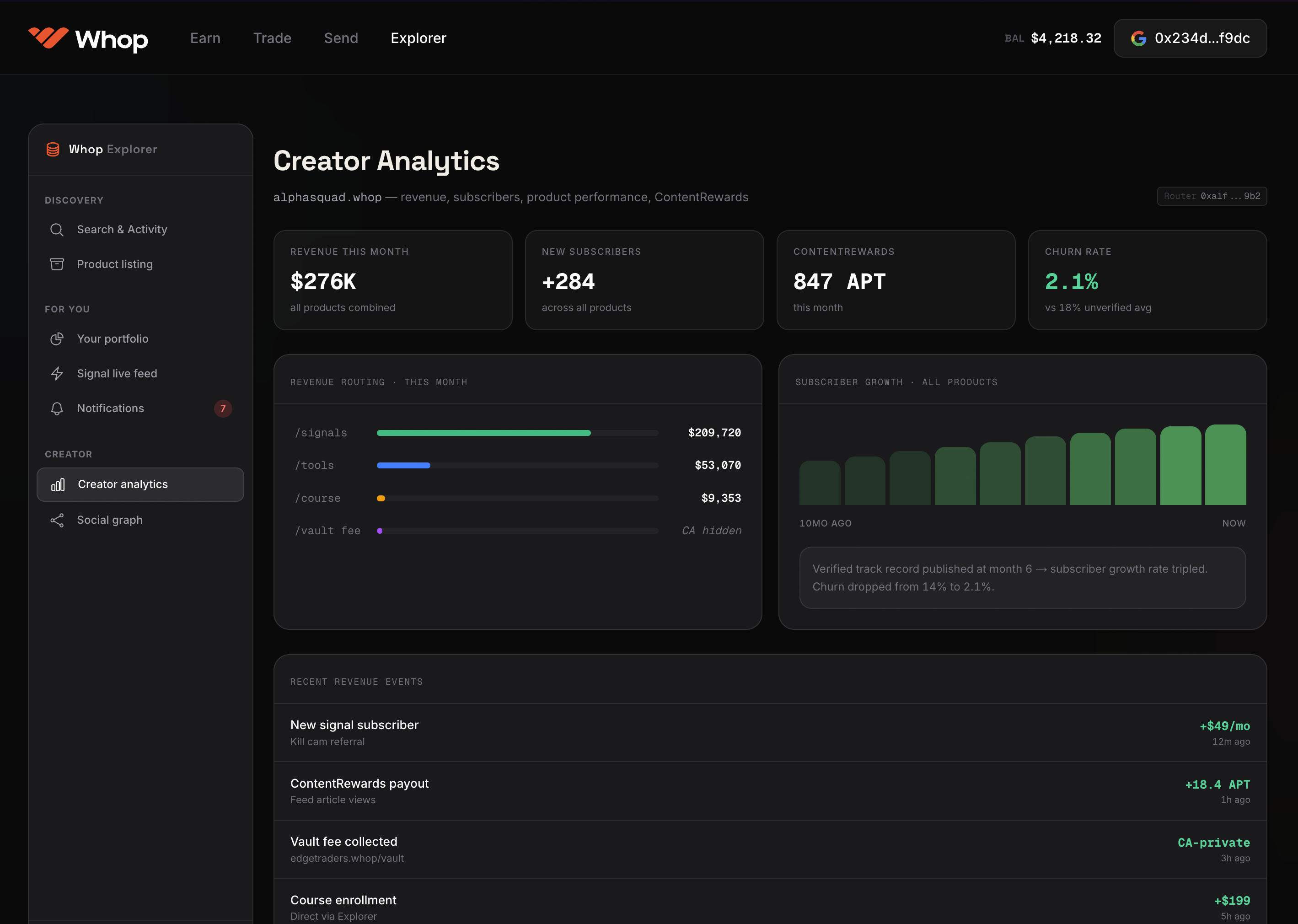
Content Rewards is the marketplace where clippers find work and creators earn from distribution. Every trade that produces a PnL card is auto-clipped: the chart, the trade execution, the indicator that fired, and the resulting card, all recorded to Shelby. No face, no identity, no wallet leak (UTT and CA cover those). Both winning and losing trades are recorded, so there's no cherry-picking.
That raw library lives on Explorer. Clippers browse it, take footage they want, add captions, animations, and commentary, and post the polished version on TikTok, YouTube, Instagram, and X. They earn based on verified views. Live today at contentrewards.xyz.
The attribution split:
- ›50% to the content creator (
.whopname) - ›25% to their community or signal group (
.whopname) - ›20% to any indicator referenced in the trade (
.whopname of the indicator creator) - ›5% to Whop
A passive view counts 1x. A view that converts to a copy-trading subscription or signal-group membership counts 10x. Creators earn more for content that drives platform behavior than content that just gets watched.
All of it flows as CA payment streams to .whop names. Attribution is public (you can see who earns from what). Amounts are private (you don't see how much).
Off-platform virality
When a clip gets shared on Twitter and thousands of people watch it, those views don't run through Shelby and don't directly pay the creator per impression. What they do is drive viewers back to Whop, where some fraction subscribes to the signal group, funds the indicator, or starts copy trading. Those actions generate revenue that flows back into the Content Rewards pool, and the engagement multiplier kicks in: the creator gets paid through conversion, not through raw external impressions. This is the part that matters for the network-effect story, virality has to land somewhere it can be monetized.
How they fit together
A trade fires on the orderbook. PnL Cards mints a record and a chart replay. The card lands on the trader's .whop profile in Explorer. A clipper browses Explorer, finds the clip, posts it on TikTok. The view drives traffic to Explorer, where someone subscribes to the signal group or funds the indicator. That subscription pays the creator on a CA stream. Content Rewards splits revenue across the attribution chain. Terminal pushes the moment to live subscribers in real time. Feed turns the trade thesis into a paid article.
It's one loop, not four products. The four surfaces are just different ways of consuming the same identity graph.