Aptos's trading stack took four years to reach production-grade. From Alex Kahn's first onchain CLOB experiment in April 2022 to Decibel live on mainnet in February 2026, every primitive Whop needs was built in the open on one chain. This page is the bird's-eye view. Product-level detail lives on the individual product pages.
The timeline at a glance
| Era | Date | What it means |
|---|---|---|
| Alex starts building Econia on Aptos | April 2022 | The Facebook/Libra engineering team becomes the first runtime capable of hosting a fully onchain orderbook |
| Econia raises from Dragonfly for CLOB | March 2023 | Onchain atomic matching + settlement ships as working code. The blueprint every later onchain CLOB borrows from |
| Aptos trading architecture matures | 2024 to 2026 | BigOrderedMap, Block-STM v2, AIP-20, Archon, and Prefix Consensus. Exchange-grade primitives + multi-leader BFT arrive at the protocol level |
| Aptos Labs launches Decibel | Mid-February 2026 | The first perps venue built on those primitives; $1.27B cumulative volume within weeks of mainnet |
| Whop white-labels the stack | Now | Perps live today. Spot, equities, commodities, FX, and prediction markets follow on the same foundation |
April 2022, Alex starts building Econia on Aptos
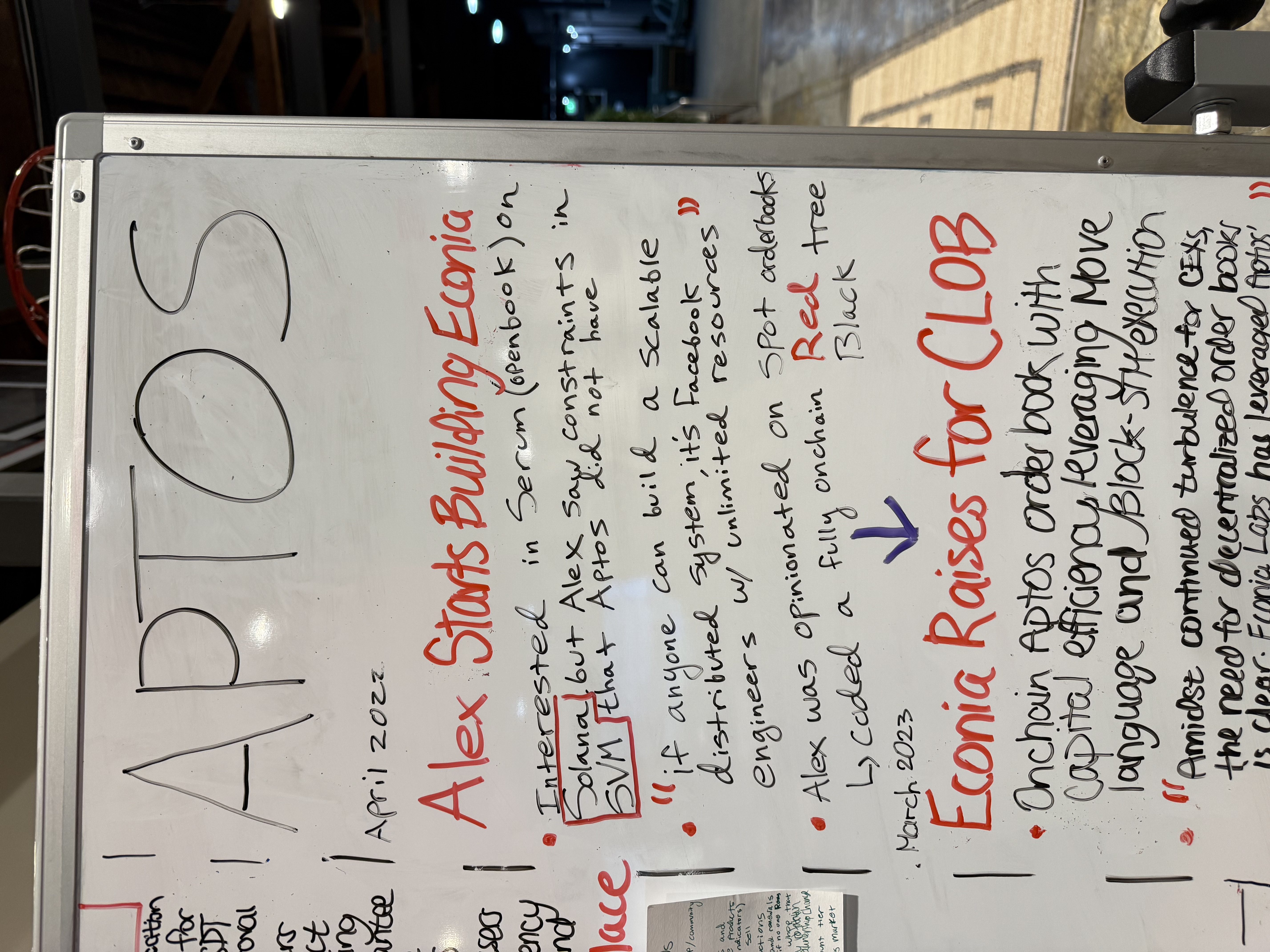
Alex Kahn starts building Econia on Aptos because Aptos Labs is the team that came out of Facebook's Libra project, the only place with the distributed-systems depth to attempt a fully onchain orderbook. Alex's thesis on the whiteboard is blunt: "If anyone can build a scalable distributed system, it's Facebook engineers with unlimited resources." He is opinionated on spot specifically, atomic, crankless, no off-chain matching engine, no settlement latency, and Aptos's Move runtime and Block-STM parallelism are the only environment where that design is viable at the time.
March 2023, Econia raises from Dragonfly for CLOB
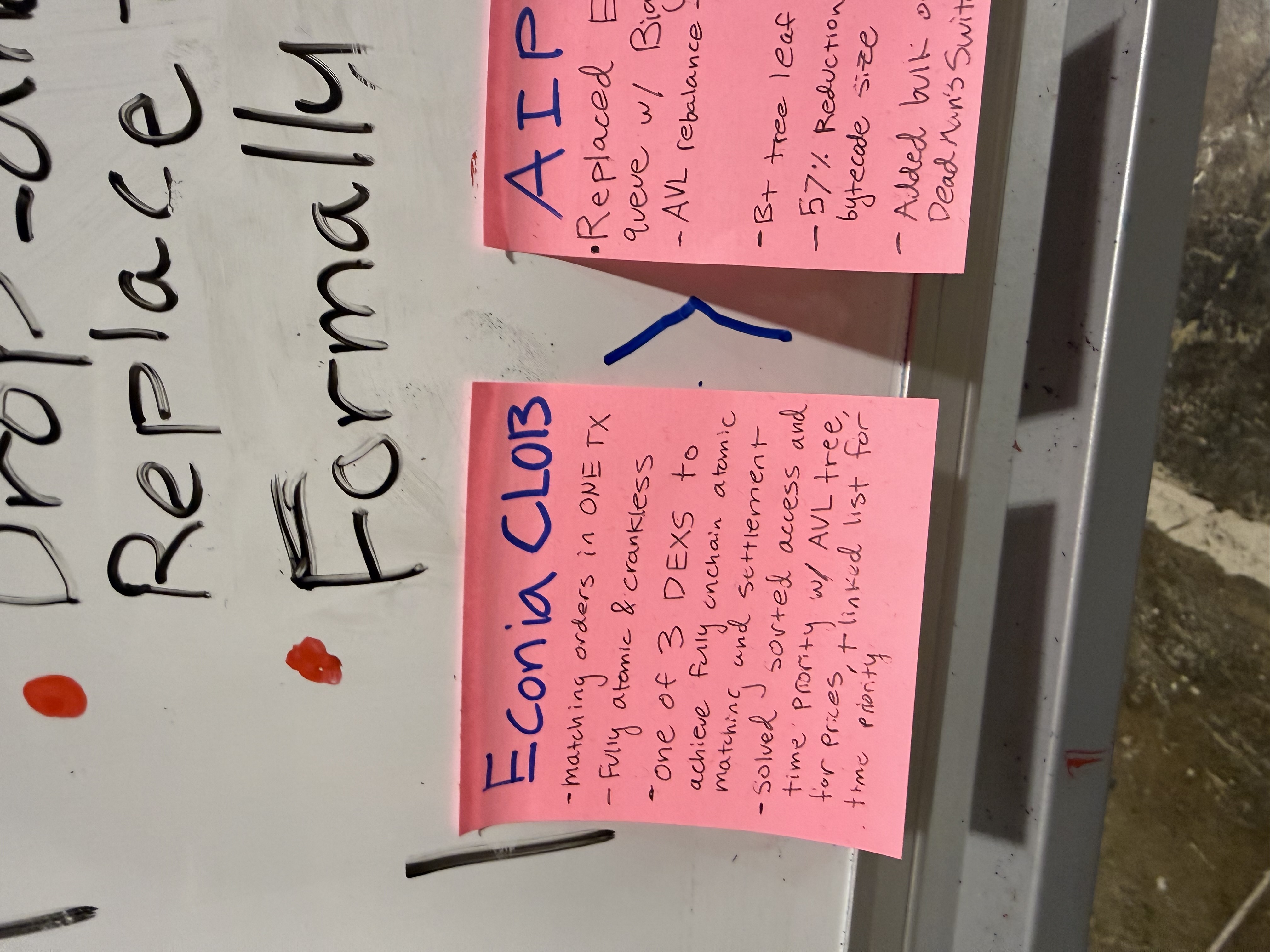
Econia Labs raises for its onchain Aptos order book, led by Kadin at Dragonfly. Amid continued turbulence at centralized exchanges, the need for decentralized orderbooks is finally obvious. What ships is one of only three DEXs in history to achieve fully onchain atomic matching and settlement in a single transaction, no crank, no off-chain engine, sorted price-time priority solved natively. The blueprint is proven. Every later onchain CLOB, including Decibel and the forthcoming Whop spot CLOB, borrows from it.
2024 to 2026: Aptos trading architecture matures
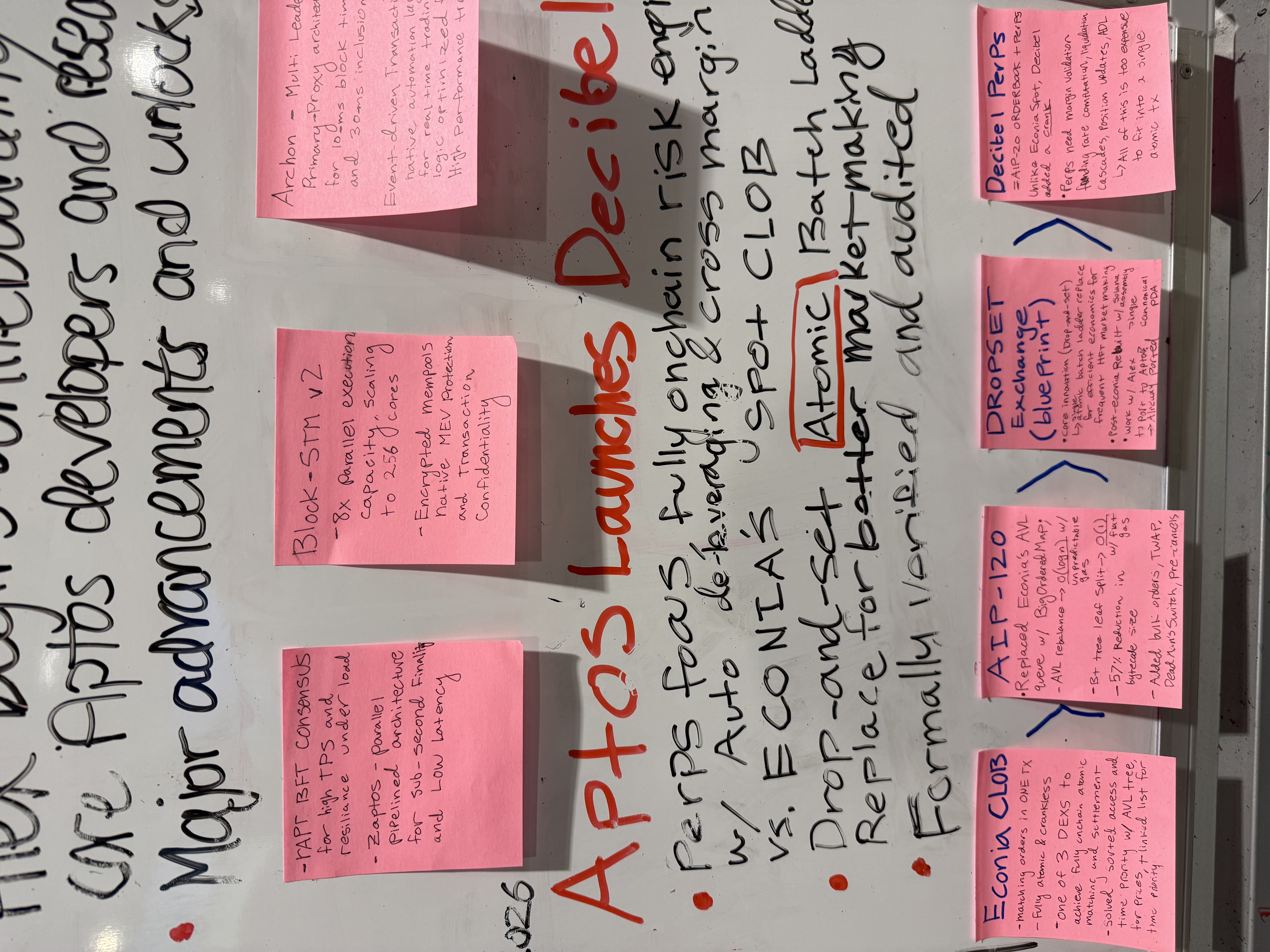
Aptos Labs uses these years to harden the runtime under a production-grade exchange. AIP-120 replaces Econia's AVL tree with BigOrderedMap, making per-operation gas predictable and cutting bytecode by 57%. AIP-20 standardizes orderbook + perps primitives at the framework level.
Block-STM v2, performance under pressure. Aptos's signature execution engine safely runs many transactions at once. V2 scales well beyond 32 cores to dramatically improve hardware efficiency, enabling a single node to process up to ~8× current capacity. That matters the moment stablecoin rails, perps funding, oracle updates, and coupon runs all fire together.
Encrypted Mempool, privacy by default. A natively encrypted mempool keeps transaction payloads hidden from submission through block inclusion. No front-running, no orderflow leakage, no new trust assumptions. The result is institutional-grade confidentiality combined with public, auditable settlement the moment execution completes.
Archon, near-instant confirmations. A primary-proxy leader architecture where a small, co-located validator cluster behaves as a single BFT stable leader. Archon is Aptos's next step toward CEX-level responsiveness, delivering ~30 ms inclusion confirmations and ~10 ms block times while preserving BFT security. Traders, payment flows, and RWA platforms get deterministic confirmation at the speed modern markets expect.
Prefix Consensus: Multiple Concurrent Proposers (MCP). Sasha and Balaji's research puts Aptos on track to be one of the first decentralized L1s with multi-leader BFT consensus. Standard BFT designates one proposer per round. That seat is what lets a validator reorder the mempool and extract MEV by sandwiching live orderflow. It's the structural source of toxic flow in onchain perps: a single sequencer with full visibility into the book is a privileged counterparty by definition. With MCP, validators propose concurrently and the protocol merges their prefixes. No single validator sees the full orderflow or sequences transactions alone. Toxic flow stops being a consensus-level reward. That's the new trade proposition. Not cloning tradfi onchain with a privileged matching engine next to a privileged risk team, but a venue where execution fairness is guaranteed by consensus itself. That's the condition under which onchain trading becomes the leading indicator of price discovery and capital at scale eventually settles here. Hyperliquid, Lighter, Solana, and Sei haven't shipped it.
Mid-February 2026, Aptos Labs launches Decibel
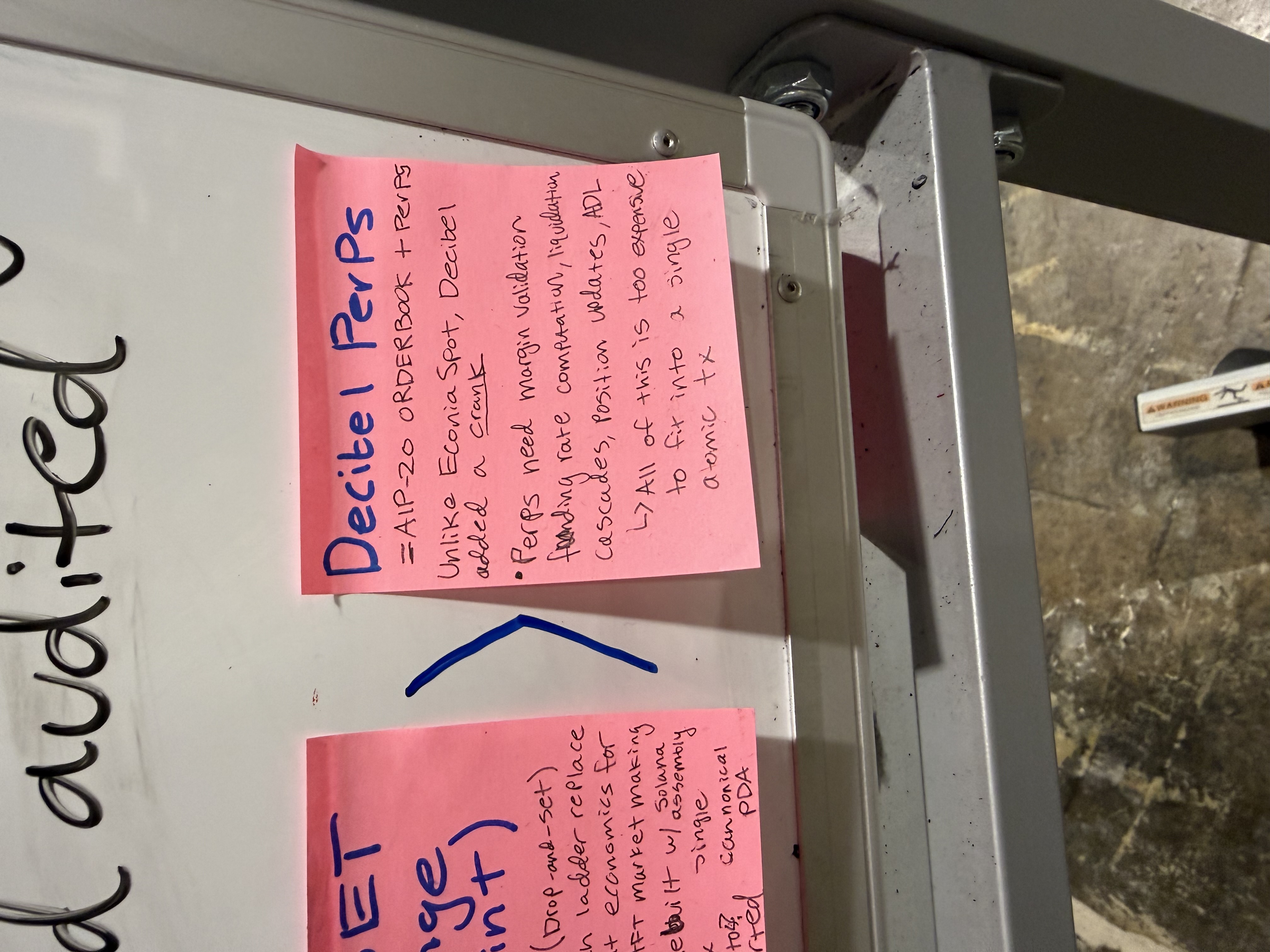
Aptos Labs launches Decibel in mid-February 2026. Perps-focused, fully onchain risk engine (including auto-deleveraging with protocol-level ADL transparency: no operator discretion on who gets deleveraged when the insurance fund is stressed), cross-margin, formally verified and audited. Where Econia was spot and crankless, Decibel adds a crank by necessity. Perps need margin validation, funding-rate computation, liquidation cascades, position updates, and ADL, all too expensive to fit into a single atomic transaction. Decibel ships with drop-and-set atomic batch replace so a maker can cancel-and-replace an entire quote ladder in one transaction. That ends the cancel wars that burn gas on competing venues where makers submit hundreds of individual cancels per second to manage inventory. That's why Decibel does $1.27B in cumulative perps volume within weeks of mainnet.
Now, Decibel live, a Whop-native exchange built on Aptos
Live today. Decibel perps on Aptos mainnet, fully onchain risk engine, formally verified, ~$1.27B cumulative volume.
On the existing roadmap. Spot orderbook is next, then onchain equities, commodities, forex, and prediction markets, all running on the same AIP-20 orderbook primitive, BigOrderedMap, Block-STM v2, and the formally verified drop-and-set market-making pattern Decibel already ships.
Beyond the roadmap, meeting Whop users where they already are. Whop is not getting a white-label skin of Decibel. Aptos Labs is tailor-making a trading product for Whop on top of those shared primitives, which opens space to meet creators and traders where they already operate:
- ›Verifiable indicator marketplaces. Indicator sellers publish strategies whose backtest and live performance are cryptographically attested onchain, not screenshotted in a Discord. Buyers pay for proven edge, not claims.
- ›Onchain-proof signal groups. Signal callers must execute on the orderbook before the call publishes to followers. Every call comes with a provable timestamp and a provable position, no publishing after the move, no hiding losers.
- ›Community vaults. Pooled subscriber capital routes through the exchange under transparent strategy rules. Performance is public by default, attribution is automatic, and allocation decisions are not made off-chain.
- ›Copy-trade routing. Subscribers auto-mirror a caller's live positions, billed per actual second of mirroring through onchain payment streaming instead of flat monthly subscriptions.
- ›Per-use monetization for strategy sellers. Indicator creators earn per actual execution of their strategy, paid out atomically at the point of the trade rather than as a flat fee that rewards coasting.
These are possibilities the tailored product unlocks, not Decibel roadmap items. The thread tying them together is monetization that does not compound Whop's existing trust problem, every new surface settles on verifiable performance rather than marketing claims.
Above all, Aptos Labs wants to help Whop serve its users better and stand out in a market where trust is the scarcest resource, and we're open to working with the Whop team to build whatever Whop's creators and traders actually want. Whop brings the 21M-user distribution layer. Aptos brings the most production-grade onchain exchange infrastructure anyone has built, tuned specifically for how Whop's creators and traders actually operate.
For the product-level detail: see Spot Orderbook Exchange for the four privacy layers, QuoteIntent, and the crankless atomic taker sweep. See Decibel Exchange for the onchain risk engine, Bulk Orders mechanics, and audit status.