The indicator category is 639 products on Whop today: a large, active, paying audience grown entirely on distribution. The legitimate creators in this category are serious quants and builders, but the category as a whole lacks a proof mechanism. 97.5% of listings claim AI while only 3.3% show any backtesting. 37 of the top 200 products are the ones actually shipping a usable TradingView script. Buyers can't distinguish the real strategies from the performative ones before paying, so the real builders pay the reputation cost of the category.
The Indicator Marketplace is the version of this category where a creator's proof is a first-class artifact, not a screenshot. The strategy is a Move module deployed onchain. The backtest is a Monte Carlo run against two years of Pyth data, with the certified stats committed to chain at deploy time. Execution is automated by AIP-125 scheduled transactions firing trades on Decibel perps. Every signal is attributed to the creator's .whop name. Every trade produces a verifiable PnL card. The creators who have been waiting for distribution credit for their actual edge finally get it, and the buyers get a discovery surface where the Sharpe ratio on the leaderboard is the Sharpe ratio the strategy has actually produced.
What you do as a trader
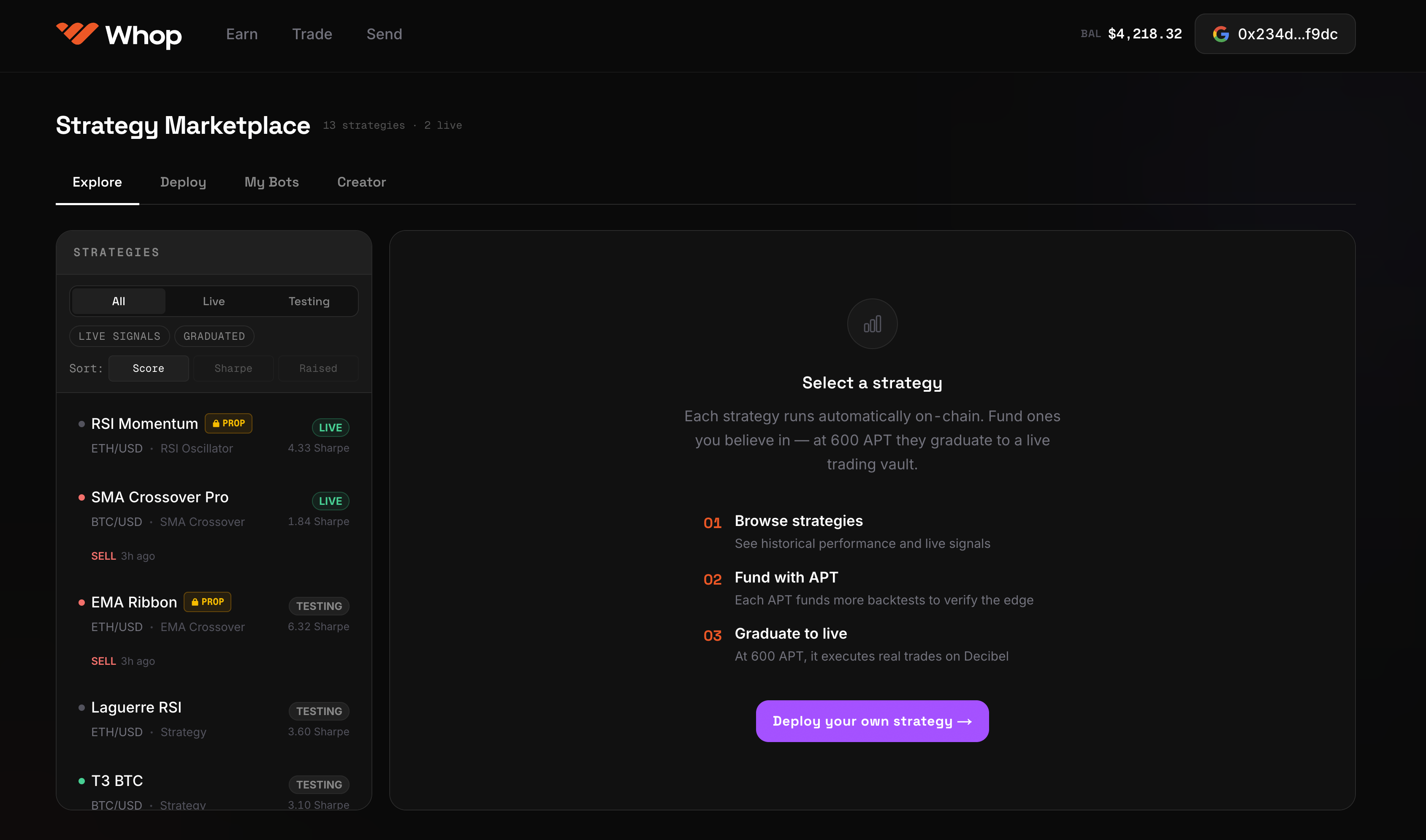
You browse the marketplace and see two numbers next to every strategy: the backtest Sharpe and the live Sharpe. The gap between them is the most important data point in the entire app. A 2.4 backtest with a 0.6 live Sharpe after three months is curve-fitting, and Explorer flags it. A 1.4 backtest with a 1.5 live Sharpe is real alpha.
You pick one, set your allocation, and confirm. The bot starts executing for you immediately. AIP-125 means there's no keeper to trust, no off-chain cron, nothing to maintain. The strategy fires a signal, your position opens, the chart replay records, the PnL card mints. You watch your live PnL on a dashboard that updates from onchain state.
If the strategy stops firing for 30 days, or its live Sharpe drops below threshold, Explorer surfaces a staleness flag. Zombie indicators don't get to coast on old backtest glory.
What you do as a creator
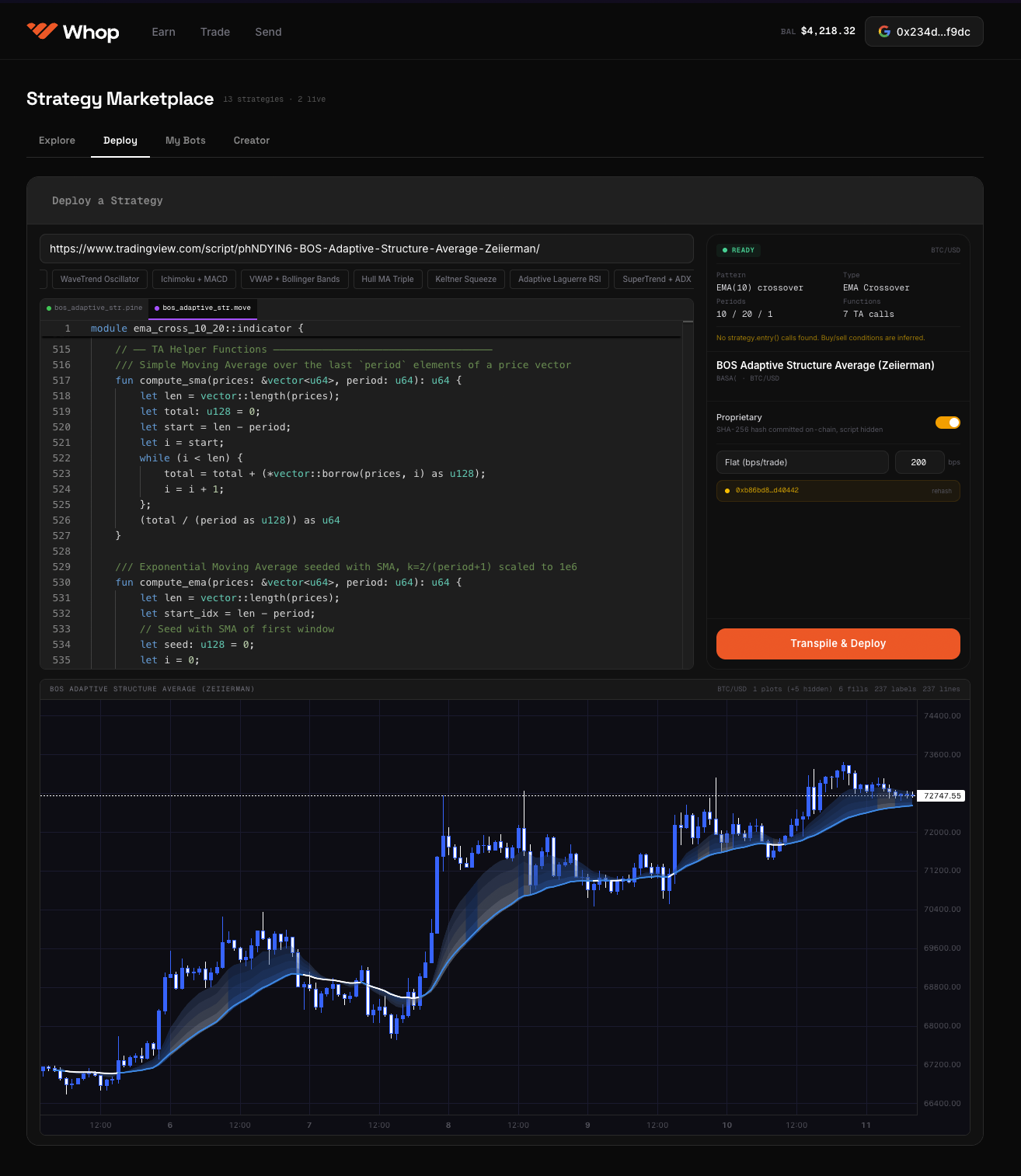
You write your strategy in PineScript v5. The transpiler converts it to a Move module. The Monte Carlo backtester runs up to 10,000 simulations against two years of Pyth OHLCV data and produces six certified stats: Sharpe, win rate, max drawdown, expectancy, average trade duration, profit factor. Those six numbers get committed onchain at deploy. They cannot be edited.
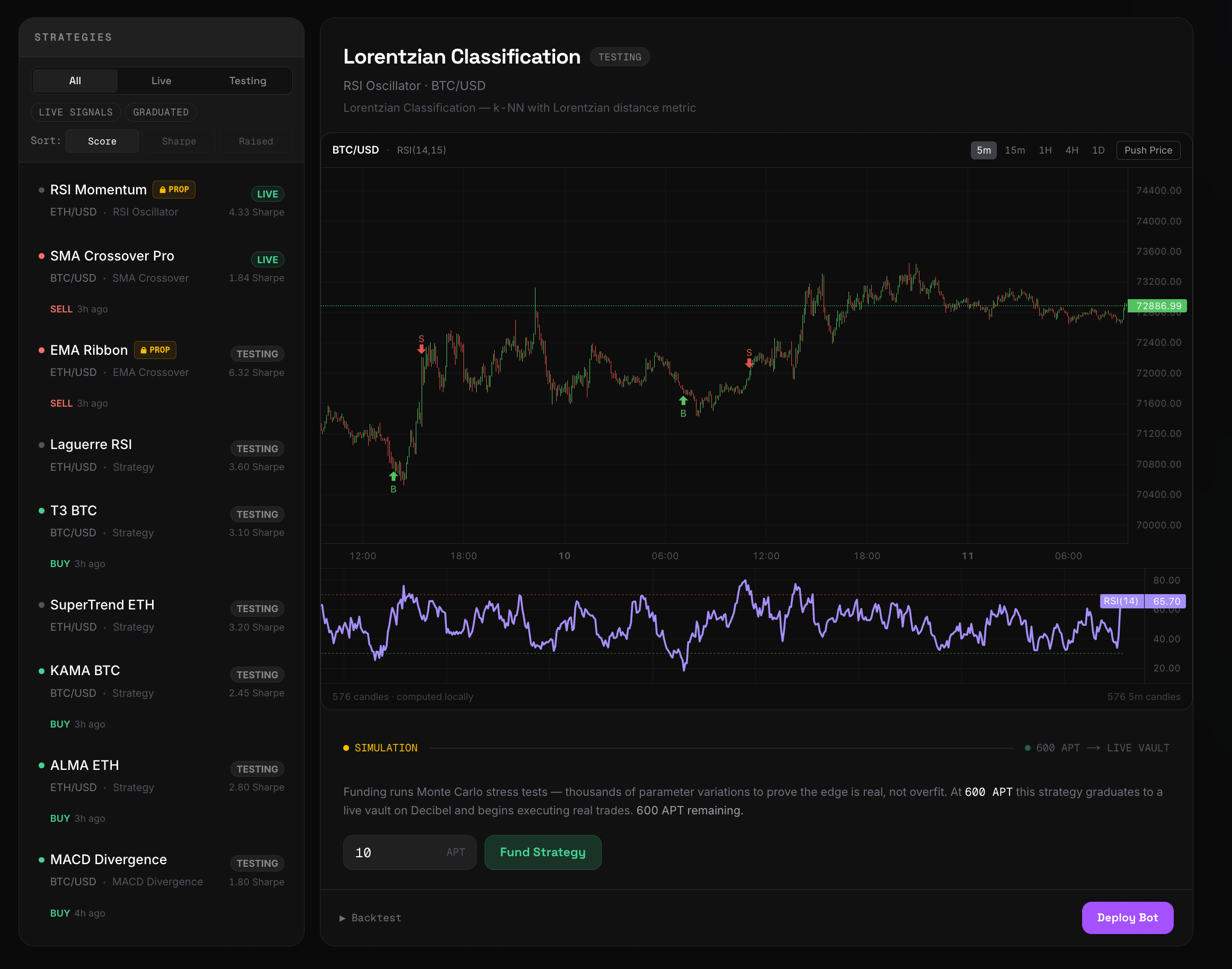
You launch via a bonding curve (the launchpad component of the marketplace, x·y=k AMM with virtual liquidity). Early funders get better prices. Once you raise 600 APT, the strategy graduates and goes live for the broader marketplace. The bonding curve is the funding validation: if the market doesn't believe in your strategy, you don't graduate.
After graduation, you earn a CA payment stream per profitable signal fired. Revenue is tied directly to performance, not subscriber count. Every signal is attributed to your .whop name, so your reputation compounds across versions and across strategies.
If you want to ship v2, you push a new version. New backtest required. New Sharpe certified. Old subscribers can stay on v1 or migrate. The full version history is visible on Explorer. There is no silent mutation, no bait-and-switch.
Why the proofs hold
Backtest. Monte Carlo runs onchain using 0x1::randomness for seeds. Stats are committed at deploy. The full simulation dataset (10K equity curves, trade logs, drawdown distributions) is too large for onchain storage, so it's ACE-encrypted on Shelby with the content hash committed onchain. Swap the data on Shelby and the hash mismatches.
Live performance. The Sharpe and PnL on the leaderboard come from Reclaim zkTLS proofs against actual exchange data, not self-reported numbers. The platform never sees raw trades.
Execution. AIP-125 fires the trade automatically when the indicator's onchain logic crosses its threshold. There's no human in the loop choosing which signals to publish. Win or lose, every fire produces a chart replay.
Privacy. Subscriptions and creator earnings flow as Confidential Assets streams (amount private, attribution public). Trade execution settles through UTT, so a competitor watching the chain can't reverse-engineer the strategy by mapping who trades when. Full backtest data is gated to launchpad funders above the graduation threshold via ACE.
Where it actually stands
The marketplace runs end-to-end on Aptos testnet today. 12 indicator types are deployed as Move modules (SMA, EMA, RSI, MACD, Bollinger Bands, Stochastic, SuperTrend, Donchian, KAMA, ALMA, T3, Laguerre). The bonding curve, the onchain backtester with 0x1::randomness, the fixed-point math library, the PineScript-to-Move transpiler, and 14 backend routes for the marketplace surface are all working.
What's blocking mainnet deploy is AIP-125. The scheduled-transaction primitive that fires bots without a keeper isn't on mainnet yet. We can ship to mainnet today with our own keeper service (already built) running off-chain in the interim, and swap to AIP-125 the moment Aptos Labs ships it. That's a few weeks of work, not a redesign.
CA streams (live on mainnet next week per AIP-143) unlock the subscription payment layer. UTT trade settlement is blocked on Invisible Assets being implemented by Aptos Labs. Until then, executions can use either CA-private margin via Decibel or post in the clear with block-timestamp attribution.
What this fixes about Whop's existing market
Whop manually verifies 0.35% of its trading products today. Verified products average 14,357 members. Unverified products average 668. The 21x gap isn't about quality, it's about Whop's Trust and Safety team's manual capacity to review 27,000+ products.
The Indicator Marketplace replaces that bottleneck with onchain proof at scale. Any creator with 90 days of verified live performance and a live Sharpe above threshold gets the equivalent of a verification badge automatically. The 21x member gap becomes accessible to any creator who can prove real alpha, not just the ones who waited in line for Whop's review queue.
It also unlocks the Content Rewards flywheel for indicator creators. Most of the existing signal/indicator products on Whop have zero CR campaigns. Verified live performance auto-unlocks CR budget. The attribution chain runs cleanly from indicator → signal → trade → PnL card → chart replay → Explorer.
How it connects to the rest of the stack
A vault can attach an Indicator Marketplace strategy as its execution logic and pool capital from contributors against it. A signal group can reference an indicator's verified live performance to bolster its track record. Every trade an indicator fires produces a PnL card that lands on the creator's .whop profile in Explorer. The marketplace isn't a standalone product. It's the execution layer that the rest of Whop composes on top of.
Technical appendix
End-to-end flow
- 02Creator writes PineScript v5
- 04Transpiler converts to Move module
- 06Monte Carlo backtester runs against 2yr Pyth OHLCV data
- 08Certified stats committed onchain at deploy: Sharpe, win rate, max drawdown, expectancy, average trade duration, profit factor
- 10Full backtest dataset ACE-encrypted on Shelby with content hash committed onchain
- 12Bonding curve opens for funding
- 14Keeper pushes Pyth prices onchain every 60s, evaluates scheduled jobs, fires trades when conditions met
- 16Creator earns CA payment stream per profitable signal fired
What a trader actually sees, step by step
| Step | What happens | What's verifiable |
|---|---|---|
| Explore | Browse marketplace of live indicators. Backtest Sharpe, live Sharpe, win rate, funding status. Filter by asset, timeframe, strategy type. | Backtest stats committed onchain at deploy. Live stats Reclaim-attested. The gap between backtest and live Sharpe is the overfitting signal. |
| Backtest | Before subscribing, view Monte Carlo results: equity curve, drawdown distribution, six stat boxes. Full simulation data available to bonding-curve funders. | 10,000 simulations against 2yr Pyth OHLCV. Full dataset ACE-encrypted on Shelby with onchain content hash. |
| Deploy | One-click deploy. Set allocation, choose leverage, confirm. Bot starts executing automatically via AIP-125 scheduled transactions. | Allocation amount CA-private. Bot execution timestamps onchain. No manual intervention after deploy. |
| Monitor | Live dashboard: candlestick chart with indicator overlays, real-time PnL, signal feed, active position status. | Every trade generates a chart replay on Shelby. PnL cards Reclaim-attested. Trade history permanent and immutable. |
| Earn (creators) | Creator dashboard: total earnings, per-signal revenue, subscriber count, Content Rewards from viral chart replays. Withdraw anytime. | Earnings flow in CA (amount private, attribution public). Every signal attributed to creator's .whop name. |
Why two oracles
Pyth provides the real-time price feed (5s polling, used by the keeper to evaluate live trigger conditions). Shelby stores the historical OHLCV candle archive that the Monte Carlo backtester runs against. Pyth is the live oracle. Shelby is the historical data warehouse. Both are required, and they don't substitute for each other.
Versioning and mutability
Indicators are immutable per version. Deployed logic can't be silently changed. This prevents the obvious attack: creator launches with a great backtest, raises 600 APT on the bonding curve, then silently mutates the indicator to a different strategy.
Versioned updates allowed:
- ›Creator pushes v2 → new backtest required → new Sharpe certified onchain → new Shelby content hash for full simulation data
- ›Minor update (parameter tweak, bug fix): bonding curve funding carries over, subscribers auto-migrate with notification
- ›Major update (new signal logic): bonding curve partially resets, subscribers choose v1 or v2 explicitly, both versions stay live
Explorer shows the full version history: v1 backtest, v1 live Sharpe, v2 backtest, v2 live Sharpe, side by side. When a vault switches its attached indicator, the switch is recorded onchain with a timestamp. Contributors can see when and why the strategy changed.
The 21x verification gap, applied to indicators
Whop's existing manual verification creates a 21x member gap: verified products average 14,357 members, unverified average 668. Only 0.35% of trading products are manually verified by Whop's Trust and Safety team. The bottleneck isn't quality, it's Whop's review capacity against 27,000+ products. The marketplace replaces that bottleneck with onchain proof at scale: 90 days of verified live performance plus a live Sharpe above threshold auto-grants the verification badge equivalent.
Examples of failure modes the marketplace prevents
- ›MomenumX ($33.4M). Coaching disguised as an indicator product.
- ›Alertsify ($27.2M). "Dashboard said I was profitable while my account got wiped."
- ›97.5% / 3.3%. Of 639 indicator products on Whop, 97.5% claim AI. 3.3% have backtesting.
- ›37 of 200. Of the top 200 indicator products by revenue, only 37 deliver an actual TradingView script. 31% deliver a video course (not an indicator).