Trading funds on Whop have three failure modes: the caller doesn't prove they entered first, the PnL is self-reported, and revenue distribution is manual and opaque. Community Vaults fix all three by pooling capital into Decibel with onchain proof at every step.
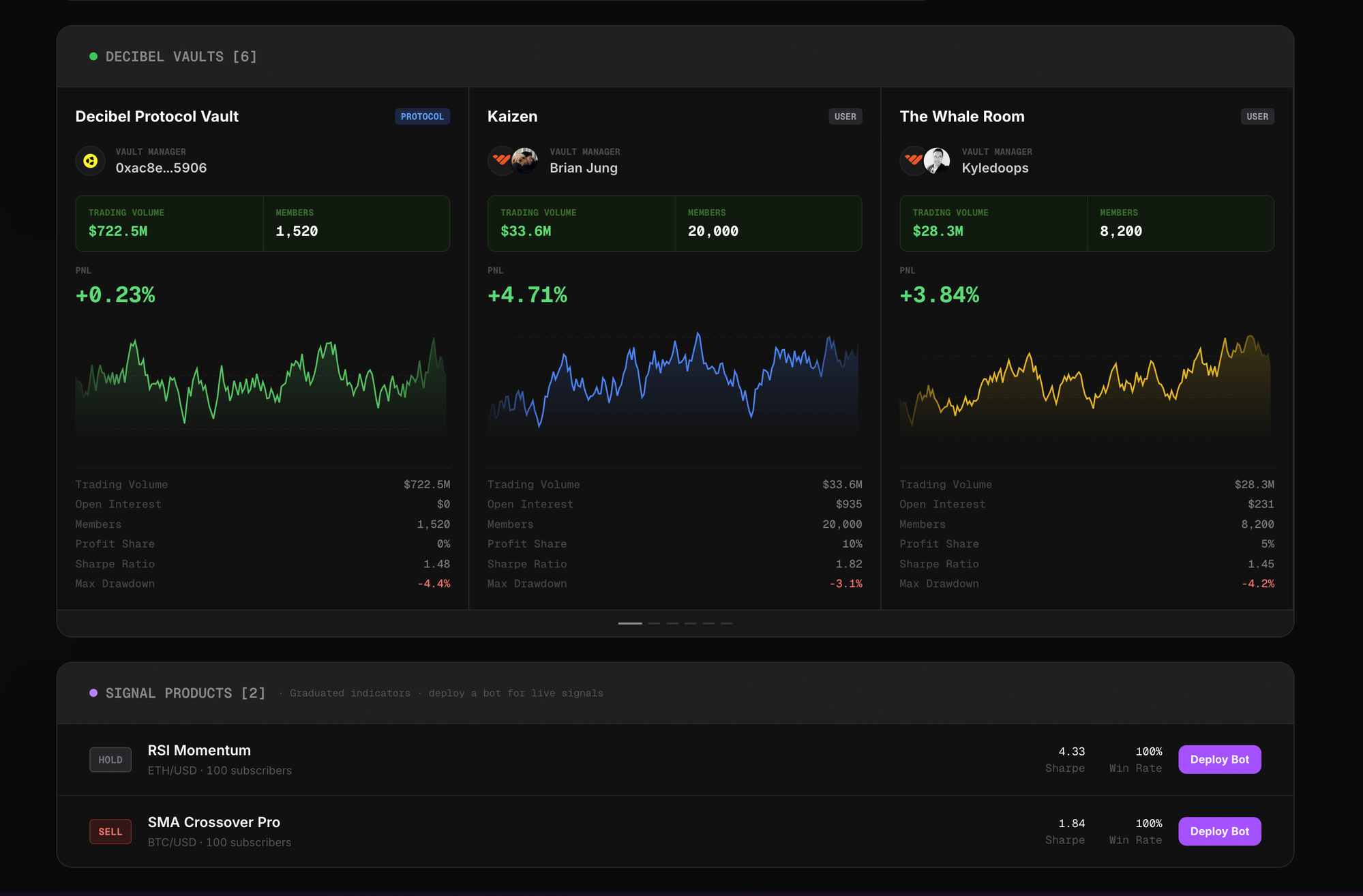
Vault Structure
Community-owned trading pools that execute directly on Decibel perps. Any Whop trading community can open a vault, attach an indicator or signal strategy to it, pool capital from members, and auto-execute trades. All positions are UTT-private and all revenue distributions are automated onchain.
Vault Lifecycle
- 02Community opens vault on Decibel
- 04Attach indicator (fully automated) or signal caller (human-in-loop)
- 06Members stake capital (CA-private amounts, or UTT for full transfer privacy)
- 08Strategy fires → vault auto-trades on Decibel
- 10Trade closes → chart replay + PnL card minted
- 12Revenue streams to all contributors via CA payment streaming
- 14The Whop Explorer shows vault's verified track record under its .whop name
Capital Structure
Each contributor's stake can use CA (Confidential Assets) to hide amounts. No individual's share size is visible onchain. Twisted ElGamal encryption conceals balances and transfer amounts while wallet addresses remain visible. For contributors who need full identity privacy on their transfers into and out of the vault, UTT can be used at the transfer layer to hide wallet addresses and break the trade graph. The vault's total position on Decibel's orderbook benefits from CA margin privacy. Competitors can't see the vault accumulating a large leveraged position.
Course fee → vault stake conversion. A $199 course fee can be converted directly into a $199 vault stake. Creator and student incentives align completely. Both profit if the strategy works. The course is no longer sold as information. It's sold as access to the upside.
Emergency exit. Any contributor can withdraw their stake at any time, subject to a cooldown window to prevent mid-trade exits that would destabilize open positions.
Vault contributor voting. Switching the attached indicator or signal caller requires a contributor vote, not a unilateral manager decision. Strategy changes are also logged onchain with timestamps. Contributors can see when and why the strategy changed.
Strategy Attachment. Two Modes
Indicator-attached vaults (fully automated): AIP-125 scheduled transactions auto-execute on Decibel perps the moment the onchain indicator fires. No human latency beyond the 60s Pyth price push cycle. The vault manager sets a max leverage cap that applies to all positions. Contributors can see the risk parameters before staking.
Signal-attached vaults (human-in-loop): Caller posts signal → vault auto-executes proportionally across all contributor stakes simultaneously. No member needs to be online. All contributors execute at the same price, not sequentially.
Multi-indicator support: A vault can attach multiple indicators with weighted allocation, for example 60% RSI crossover strategy, 40% SuperTrend breakout. The weighting is set at vault creation and changes require a contributor vote.
Bulk Orders on Decibel (April 2026): Vault's batch order submission makes large multi-stake execution significantly more efficient. One Bulk Order covers all contributor proportions in a single atomic transaction.
ACE-encrypted Vault Strategy
Vault strategy configuration. Indicator parameters, position sizing rules, entry/exit logic, leverage cap. Can be ACE-encrypted and stored in the Move struct or on Shelby. Only addresses with a stake in the vault can decrypt via the vault membership contract as ContractID.
This means competitors can see the vault's name, track record, and that it runs a "momentum strategy", but not the specific indicator parameters, the entry/exit logic, or the position sizing rules. The vault's edge stays private to contributors.
Revenue Distribution
Real-time via CA payment streaming. When the vault closes a profitable trade, earnings distribute to all contributors immediately via CA payment streaming. No weekly settlement. No manual claim. Automatic, proportional, CA-confidential.
Distribution is proportional to stake size. Each contributor's stake amount is hidden via CA (Twisted ElGamal encryption). The vault contract knows the proportional shares internally, but no external observer or other contributor can see what anyone else contributed.
CA-private amounts. Contributors see their own earnings via their decryption key. Nobody else can see the distribution amounts. Vault total PnL is also private.
Indicator creator cut. If the vault is running an Indicator Marketplace strategy, the indicator creator earns their per-signal-fired fee from vault trades too. Same economics as direct subscriptions. The vault is just another execution environment for the indicator.
Vault manager fee. Communities can set a manager fee , such as 2% of profits, flowing to the signal caller or vault operator who manages the strategy.
Content Rewards layer. Vault's chart replays generate view revenue distributed through the Content Rewards pool.
Explorer and Verification
Vault .whop name. Every vault has its own .whop product subdomain , such as alphasquad.whop/vault, with an Explorer profile, chart replay library, and PnL history under that name.
Vault PnL card on Whop Explorer. Shows the pool's verified track record. UTT timestamp on every trade, Reclaim zkTLS on every dollar figure. Public and verifiable by anyone.
Individual contributor PnL cards. Each member also gets their own PnL card showing their personal returns from the vault. Separate from the vault's aggregate card.
Chart replay on every vault trade. Every auto-executed trade generates a Shelby-stored recording. The vault's full trading history is watchable, not just a number on a leaderboard.
Backtest shown before staking. If indicator-attached, Whop Explorer shows the full backtest Sharpe plus live Sharpe divergence for the underlying strategy. Contributors can evaluate before committing capital.
QVAC queries. "Show me all vaults running RSI strategies with live Sharpe above 1.5 over 3 months". Once QVAC can query across the indexed vault data on Shelby, Whop Explorer becomes a genuine fund discovery engine.
Why This Beats a Typical Copy Trading Fund
Traditional signal group funds have three failure modes:
- 02The caller doesn't enter first (can't prove it)
- 04The PnL is self-reported (can't verify it)
- 06Revenue distribution is manual and opaque (can't trust it)
Whop vaults solve all three simultaneously:
- ›UTT proves entry timing (caller must execute first, nullifier records when)
- ›Reclaim proves the dollar figure (zkTLS against actual exchange account)
- ›CA payment streaming makes distribution automatic and auditable